
Anchoring Students to Reduce Stress and Boost Grades
Westwood High School is a 9-12 school in Westwood, Massachusetts, a town of about 16,000 people just outside Boston. The school serves roughly 889 students and about 181 staff, with around 131 teaching staff using MyFlexLearning. Westwood brought in MyFlexLearning in the 2021-22 school year to manage S Block, a daily Support Block built directly into its master schedule.
Westwood built S Block around years of student feedback about stress and a lack of time in the day, then used the disruption of the pandemic as the moment to finally launch it. Before COVID, Westwood ran a 7-by-8 schedule with no dedicated flex time anywhere in the day, and teachers covered study halls seven out of every eight days. Alongside the stress feedback, the school also gathered sleep data and found most students were averaging around five hours a night, adding urgency to conversations about the demands of the school day. When Westwood began planning its return from hybrid learning, a working group studied peer schools’ schedules and used the moment to build in the time students had been asking for since 2015. Every student now defaults into an assigned Anchor Room each day, a consistent home base they can flex out of into extra help, enrichment, or teacher-created offerings.
“We heard for years and years how stressed our kids were and how there wasn’t enough time in the day,” said Aishleen Marcus, Dean of Students at Westwood High School.
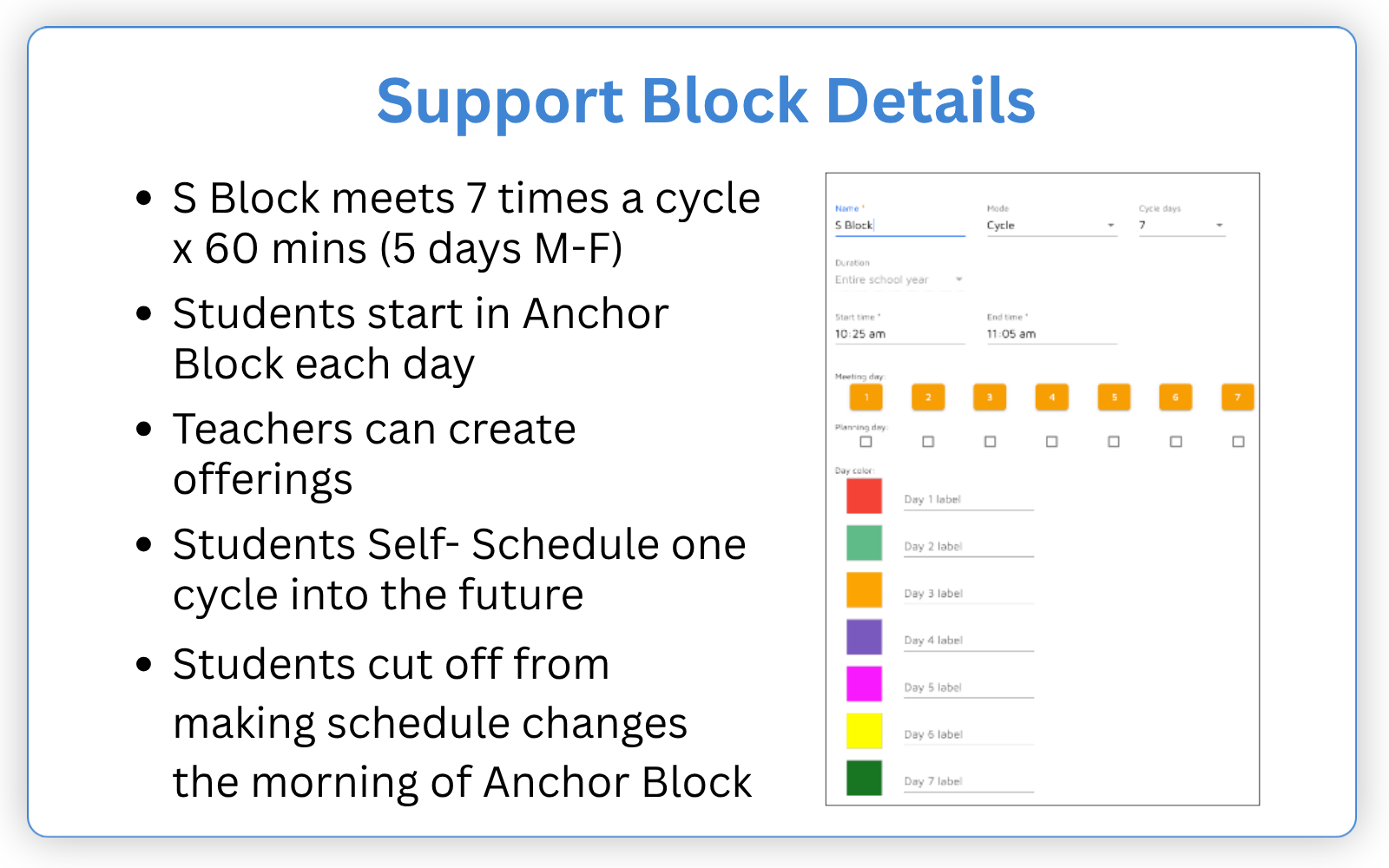
Westwood runs a 7-day, 6-period rotating schedule, with S Block meeting for 60 minutes at the same fixed time every day, even as the rest of the schedule rotates around it. During the 2022-2023 school year, Westwood offered 582 unique S Block classes, totaling 22,522 session instances, about 125 offerings a day. Students and staff made 298,808 schedule changes over the year, and 87,467 of them were made by students themselves.
Guardrails Built from Experience
Students can self-schedule into S Block, but only one cycle into the future, a limit Westwood added after students originally allowed to schedule the entire year ahead began locking themselves into the same activity, like basketball, every single day. Westwood also cuts students off from making changes at 7 a.m. the morning of, closing a loophole where students had signed up for “extra help” with teachers who were out that day in order to leave campus.
Seniors are the exception to the Anchor Room default, treating S Block as free time as part of Westwood’s privilege system, while juniors with lab requirements are automatically locked into their labs on the appropriate day, synced nightly from their SIS, Aspen.
Building the coverage schedule each year is its own puzzle. Administrators lock in teachers with lab responsibilities first, then assign each department a shared team planning day, offsetting departments so no two teachers who might need the same coverage day are left without backup. The payoff is a lighter duty load school-wide: teachers now have only two possible S Block duties, Anchor Room coverage or lunch duty, replacing a schedule that once required covering study halls seven out of every eight days.
A Cultural Shift
What started as a home base for academic support has grown into something students actively look forward to. Teachers now run offerings like open gym, a “Zen Den” relaxation space, therapy dogs, a walking club, trivia, and holiday Bingo, alongside guidance seminars and the original core of extra help. Class meetings and guest speakers now happen during S Block too, giving the school room to build community without pulling students out of academic class time. Marcus has noticed a visible shift among seniors, who increasingly choose to stay on campus during their free S Block time rather than leave.
The system also handles more sensitive needs quietly. Westwood’s school psychologists create S Block sections for students receiving IEP-related counseling services that students can’t search for or see, so support happens seamlessly without singling anyone out.
“There’s no avoiding it when it’s in the middle of the day,” Marcus said, describing how building extra help into the school day, rather than after it, helped close a gap for students in Westwood’s regional district, which no longer runs after-school buses.
The Results
Westwood’s child study team, which reviews progress reports and report cards eight times a year, has tracked a notable trend since S Block launched: the number of students receiving D, F, and Incomplete grades on progress reports has been cut roughly in half compared to two years earlier.
Westwood is also using MyFlexLearning data to strengthen conversations with families, combining a student’s grades with how often they’ve actually opted into extra help.
“You’re telling me that you are seeking out your teachers all the time, but I don’t see any extra help offerings you’ve signed up for,” said Tom Millett, Assistant Principal at Westwood High School, describing the conversation the report enables. “The parents don’t look at me anymore. They look at the student.”
What's Next
Westwood is continuing to build on S Block’s foundation. A new student orientation program pairs incoming students with upperclassman mentors, and the school is exploring how to formalize those mentor check-ins during S Block itself. Westwood has also launched a pilot SEL-focused offering built directly into the block, giving the time yet another purpose beyond academic support.