
Building a Schedule Around Flex Block
The Challenge
For about a decade, Wilmington High School ran a single long flex block every other day, embedded in an otherwise seven-class schedule. The period itself was popular in concept, but in practice it was highly unstructured: teachers often didn’t know which students were coming, where they were coming from, or whether they were even permitted to be there, so they couldn’t prepare for the time in any consistent way.
The same seven-block model also created real access gaps. Students on IEPs and in learning centers had a harder time reaching the same electives their general education peers could fit into their day, an inequity that became a driving factor as administrators began to rethink the schedule.
The Solution
When Wilmington set out to redesign its master schedule, the administration surveyed students, parents, and teachers about their priorities. Little else drew consensus, but one thing did: protecting flex block. Rather than treat flex as an add-on to the academic schedule, the team built the new schedule around it first.
To fund a shorter, more frequent flex period without lengthening the school day or adding to teacher hours, Wilmington reallocated roughly 11 minutes from each academic block and added an extra elective period to keep four classes balanced across both rotation days. The result: 114-minute academic periods on a 2-day Blue/White rotation, with an 88-minute flex block running every single day instead of every other day.
The system also handles more sensitive needs quietly. Westwood’s school psychologists create S Block sections for students receiving IEP-related counseling services that students can’t search for or see, so support happens seamlessly without singling anyone out.
“There’s no avoiding it when it’s in the middle of the day,” Marcus said, describing how building extra help into the school day, rather than after it, helped close a gap for students in Westwood’s regional district, which no longer runs after-school buses.
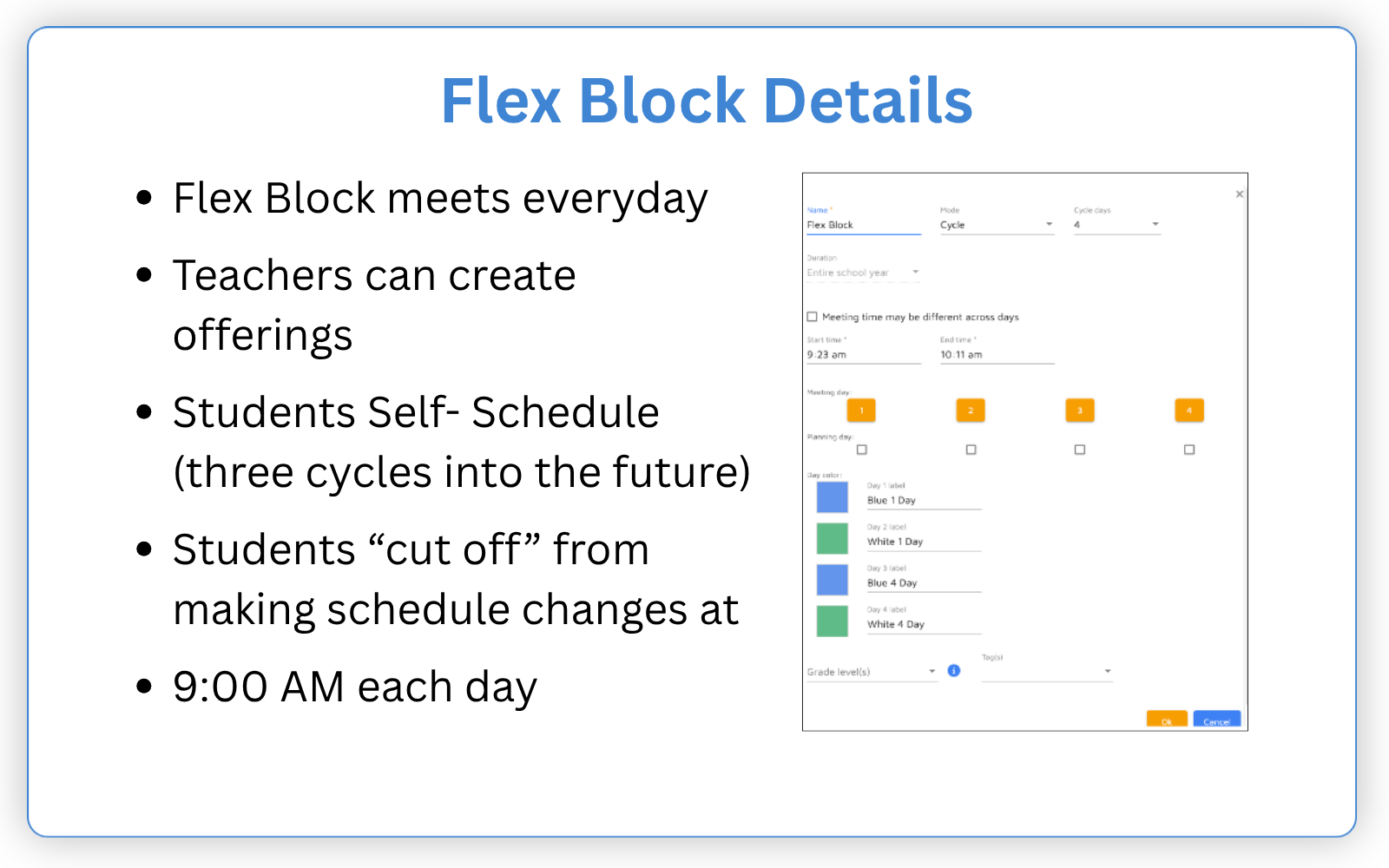
To give teachers the predictability the old model lacked, Wilmington adopted a default-location structure tied to advisory: students who don’t actively reschedule stay with their advisor, so every teacher knows at baseline who to expect and can prepare accordingly. New instruction isn’t permitted during flex; instead, the time is used for academic and social-emotional support, independent or guided practice, and access to spaces like the gym, fitness center, art rooms, and library. Before the new schedule fully launched, the school piloted it a few times in the spring before finals, which took much of the uncertainty out of the rollout for both students and staff.
To fund a shorter, more frequent flex period without lengthening the school day or adding to teacher hours, Wilmington reallocated roughly 11 minutes from each academic block and added an extra elective period to keep four classes balanced across both rotation days. The result: 114-minute academic periods on a 2-day Blue/White rotation, with an 88-minute flex block running every single day instead of every other day.
The system also handles more sensitive needs quietly. Westwood’s school psychologists create S Block sections for students receiving IEP-related counseling services that students can’t search for or see, so support happens seamlessly without singling anyone out.
“There’s no avoiding it when it’s in the middle of the day,” Marcus said, describing how building extra help into the school day, rather than after it, helped close a gap for students in Westwood’s regional district, which no longer runs after-school buses.
The Results
In the 2023-24 school year, Wilmington ran 493 distinct flex offerings totaling 12,782 class instances, roughly 70 opportunities available to students on any given day. Students drove nearly half of all schedule activity themselves, initiating 52,930 of 108,708 total schedule changes (48.7%), a strong signal of real ownership over how they use the time rather than passive placement.
Enrichment offerings have found unexpected traction inside the structure: when the school’s Best Buddies club moved its meeting into flex block, turnout rose noticeably compared to its previous after-school slot, prompting the school to rethink how accessible other extracurriculars could be if scheduled during the day. On the academic side, Wilmington has also observed a correlation between well-attended math flex sessions and rising math scores, reinforcing flex block’s role as more than just a scheduling convenience.
Wilmington continues to refine the system. A new tiered locking feature, expanding on the original first-come, first-served teacher lock, will let staff release a student to a higher-need class when priorities shift.